Search results for: “gretsch”

  • Kitschcaster: An Experimental Fender/Gretsch Hybrid

    Kitschcaster front

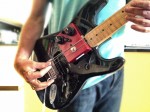
    I just completed my third DIY guitar experiment using Warmoth parts. This one is a wacky Fender/Gretsch hybrid with a semi-acoustic Fender Starcaster body, a reverse, angled Strat neck, and various Gretsch-like elements, including TV Jones Filter’Tron pickups, a Bigsby/Vibramate vibrato, and a vulgar silver-sparkle finish — a tribute to the Gretsch Silver Jet, and the basis for this new guitar’s name: Kitschcaster.

    Mind you, it sounds nothing like a Starcaster. I ordered the body (which Warmoth calls the Mooncaster) in warm-toned korina, and the neck is mahogany. (Fender used bright-sounding maple for the original necks and bodies.) True to form, the Gretsch-style humbuckers provide a percussive, “plinky” attack quite distinct from PAF-style pickups. The Bigsby assembly also nudges things further from Fenderland. But I always dug the Starcaster’s offset semi-acoustic body, and I thought it would make a nice platform for my latest platypus.

    As before, I’m 100% delighted with Warmoth’s work. The finish is flawless (correction: was flawless till I dinged it), and everything fit together beautifully. The only hurdle came when installing the wiring. I failed to take into account the body’s thinness, and I didn’t have enough room to accommodate all the big push/pull and dual-concentric pots I’d planned to deploy. The comic highlight of the build came when I somehow managed to force a standard-sized pickup selector switch into the narrow lower horn. I disconnected a wire while doing so, and then found myself completely incapable of removing the switch. I took it to repair genius Gary Brawer, whose first comment was, “How did you get this in here? And more important, why?” But he managed to free the trapped part, and then he installed a cunning little access cover. Go, Gary!

    Kitschcaster back
    Yes, the neck is silver too. Gary Brawer added the pickup selector access cover.

    I’m especially besotted with Warmoth’s “Clapton” profile necks, which I’ve used in all three of my builds. They have a pronounced V shape that feels so comfy in my left hand, and provides relief for my left thumb joint, where, sadly, I’m feeling my first tentative twinges of arthritis. It’s a trip having three radically different guitars with identical neck profiles. I dig the sleek, comfy body as well, and I love its ability to generate musically coherent feedback.

    Anyway, consider this a work in progress. I’m still fussing with the tone circuit. (If I can find suitably sized rotary switches, I want to try a sort of “double Vartitone,” with separate treble-cut and bass-cut dials. If it works out as as planned, I’ll do another post on it.) I’ll also probably jigger with the built-in distortion, taking off some of the treble. Like my Bigsby equipped Les Paul, the Kitschcaster can have overly aggressive highs. Something about the combination of the Bigsby hardware and flatwound strings makes certain notes come screaming out of the amp. Both guitars benefit from a carefully controlled touch.

    But even now, I’m really stoked about this fun, cheesy-cool instrument.

  • Loopocalypse Day 15 (of 17): “Rhiannon”

    Gawd, did I hate this song as a ’70s teen. But I sure loved Stevie Nicks in Season 3 of American Horror Story.

    This is far from the best “Rhiannon” cover, but it may be the only one based on Olivier Messiaen‘s Second Mode of Limited Transposition.

    The guitar is a bitchin’ Gretsch/TV Jones baritone on loan from a generous friend. I’m tuned down to Bb, F, Bb, Eb, G, C, low to high.

  • Suite ’66: Free EP by Goldenberg & Gore!

    suite-66-cover

    A free EP from we to thee!

    Guitar genius Mark Goldenberg and I recently recorded Suite ’66, a set of improvised duets on four tunes from 1966, in honor of the 50th Anniversary of one of the greatest years in pop music.

    We teased this “release” a few months ago with this rehearsal video. The EP features a more developed version of the same tune, plus three others.

    Even if you’re not familiar with Mark’s name, you’ve probably heard his playing. Mark has been a leading LA sideman and session player for decades. He’s worked with Jackson Browne, Linda Ronstadt, Bonnie Raiit, Waylon Jennings, Chris Isaak, Willie Nelson, Hugh Laurie, Natalie Imbruglia, and most impressively, William Shatner.

    Less well known is Mark’s beautiful solo style, which resides at the intersection of rock, classical, and jazz. I was instantly smitten when I first heard Mark play in person at one of Teja Gerken‘s solo guitar events a couple of years ago. Mark’s musicianship flabbergasted me, plus we bonded over the fact that we shared the same teacher, the late Ted Greene. (Though I studied with Ted when I was a teen, so much of his wisdom went over my head. Mark, however, worked with Ted after becoming one of LA’s most respected players, so he absorbed Ted’s insights on a far deeper level.)

    Listening to Mark play is sheer musical ecstasy, whether or not I happen to be picking along with him. He’s been one of my greatest musical inspirations of the last few years. (Translation: I’ve ripped him off more times than I can count.)

    Listen and download via SoundCloud:

    Tech notes: We recorded and mixed this in my basement studio. I’m on the left channel throughout, and Mark’s on the right. (There are no overdubs.) My instruments are a Gretsch Spectra Sonic electric baritone guitar (kindly loaned by Xander Soren), a Veillette Avant Gryphon octave 12-string, and a Taylor 150e 12-string. Mark plays two magnificent guitars: his Kenny Hill classical and a Collings 001MH steel-string.

    IMPORTANT: This non-commercial recording is shared as a gift between us and our friends. It may not be reused for any purposes, especially commercial ones. We’re simply inviting you to listen in on our jam session.

  • “Eleanor Rigby” Rehearsal

    Lucky me: I just started rehearsing for a duo project with one of my guitar heroes, the brilliant Mark Goldenberg. Here’s a run-through of “Eleanor Rigby,” one of the tunes we’re working on. It’s pretty rough still, and the recording quality ain’t great. But I love Mark’s playing so much here that I couldn’t resist sharing.

    I’ve only known Mark a year or two, but we hit it off as soon as we met at one of Teja Gerkin’s solo guitar events. Mark played ravishing solo version of so many of my favorites: “God Only Knows,” “Shenandoah,” “Wichita Lineman,” “Mood Indigo,” and more. I love his ultra-dynamic touch and beautiful Bill Evans-style harmonies. Plus he’s just an cool guy.

    And it turns out we both studied with the same teacher: the late Ted Greene. (I took lessons from Ted as a teen, with a few more sessions 20 years later. Mark studied with Ted long after he became a leading LA sideman and session player.) You can read more about Mark on his website. He’s recorded and toured with Jackson Browne, Bonnie Raitt, Linda Ronstadt, Eels, Natalie Imbruglia, Chris Isaak, Waylon Jennings, Willie Nelson, Peter Frampton and — hehehe — William Shatner. It’s a real thrill to collaborate with such an inspired player.

    I’m playing a Gretsch TV Jones baritone on loan from my pal Xander Soren. Mark’s playing his magnificent mahogany Collings.

  • Next Victim! A New DIY Guitar

    Starjet

    Look what UPS left on my porch: the neck and body for my latest ill-advised “parts” guitar project. I’ll be slapping it together in the coming days, but I couldn’t resist showing off the pretty parts. The body is Warmoth’s Mooncaster model, which is based on Fender’s semi-hollowbody Starcaster, a quirky cult guitar if ever there was one. But for the neck, I swiped an idea from Warmoth’s Josh Spataro, and substituted a reverse angled Strat neck. The tacky silver finish and extravagant binding are solely the result of my bad taste. (Josh compared it to a pinky ring, which is pretty accurate.) The body is korina, the neck mahogany.

    If my last Warmoth parts guitar was a sort of Fender/Gibson hybrid, this one is more Fender/Gretsch. I’m planning to install a set of TV Jones pickups, and this will be my chance to try out a very different type of tone control scheme, one I’ve been thinking about for a while. If it turns out well, I’ll write about it. If not, I’ll probably delete the last few sentences and deny they ever existed.

    This is my third Warmoth parts project since starting this blog. As before, I’m 100% delighted with the materials and build quality. Since I requested expensive options (like the vulgarly bound and finished neck) and I’m using fancy parts, the guitar probably won’t be vastly cheaper than if I’d bought it already made. But it should be unique and fun. Stay tuned — and I’ll hope the guitar does too.

  • How to Install Onboard Effects

    How to Install Onboard Effects

    UPDATE: I’ve added a page listing all the “How To” posts on this site. Just click the cleverly titled How-To Posts Are Here! box at upper-right of each page.

    There’s got to be a better way!

    Several readers asked for more specific tech advice on how to wire up battery-powered effects inside a guitar or bass, so I created a step-by-step tutorial, which you can download here.

    Some historical background: Since the ’60s, many guitar companies have toyed with the notion of installing battery-operated effects inside guitars.

    And “toyed” is probably the perfect verb for it. Onboard effects have earned a reputation as cheesy, low-budget products. In many cases this reputation is justified. (And sometimes it’s not — the Electra guitars of the ’80s were never particularly popular, but their simple onboard distortion circuit has generated hundreds of “boutique” clones, not to mention our own Bad-Ass Distortion project).

    And why would you want to put an effect inside a guitar or bass? You can use a stompbox with any electric instrument, but an onboard effect is married to one axe till solder-do-they-part.

    I have an ironclad rebuttal to such concerns:  (more…)

  • Baritone Guitar, Anyone?

    Baritone Guitar, Anyone?

    Any baritone guitar fans in the house? Let’s talk LOW!

    I’ve been obsessed with baritone and other low-tuned guitars for decades, but I’ve never really found a perfect method for setting up a lower-than-standard guitar, so I’m interested to hear about other players’ experiences.

    My main issue is pretty straightforward: I can get great tones by simply lowering the pitch on a standard-scale guitar, but the intonation is a nightmare, especially on the fifth and sixth strings. And when I use a longer-scale instrument, I get huge bass tones and solid intonation, but the middle and upper registers feel too thin stiff and stiff — I have difficulty making them sing.

    With standard-scale guitars, it seems to help if there’s a length of straight string-pull — like on a Telecaster — between the nut and the tuners. I used a standard Tele tuned down to BEADF#B (like standard tuning, but a fourth lower) on the Tom Waits albums I worked on in the ’90s. Fortunately, the sketchy intonation were a plus in that clangorous context. (His song “Goin’ Out West” is a pretty good example of a cool, but screamingly out of tune, guitar tone. It was played on an old Tele dropped down to B.) (more…)

  • Fun with Onboard Boosters!

    Fun with Onboard Boosters!

    Put more ELECTRIC in your guitar!

    Lately I’ve been obsessed with mounting boosters inside my electric guitars.

    Why bother? Especially when you can just get a clean-boost stompbox and use it on all your guitars? Because:

      a) certain guitars just seem to sound best with a particular boost circuit;
      b) you can “play” the booster by riding the gain setting, and;
      c) why leave well enough alone when there’s an exciting opportunity to screw things up?

    Two examples: a squeaky-clean boost inside a lipstick tube Strat (which I previously wrote about here), and a dirty little germanium overdrive inside an old Les Paul (a guitar I previously wrote about here).

    Listen to the results! (more…)

  • Pretty, Pretty Pickup

    Pretty, Pretty Pickup

    The Dynasonic: one pretty pickup!

    Take my advice: When MJ says she has something cool to show you, drop everything and investigate.

    MJ, of course, is Maricela Juarez, the longtime manager of the Seymour Duncan Custom Shop. And the item in question was a clone of the DeArmond 200 pickup, also known as the Gretsch Dynasonic®. Predating the Gretsch Filter’Tron, the Dynasonic provided one of the key sounds of classic rockabilly, and was used at times by Cliff Gallup, Eddie Cochrane, and Duane Eddy. It’s also just about the prettiest-looking pickup I’ve ever seen. (more…)