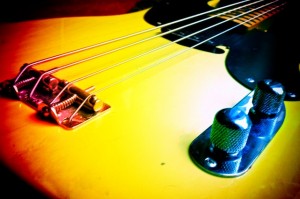
After auditioning so many different tone-control schemes over the course of the Mongrel Strat Project, I wound up with more tone circuits than I have Strats, so I figured I’d victimize a bass — specifically, a 1954 Fender P-Bass reissue with a Seymour Duncan Quarter-Pound pickup, which I’ve written about here. It’s a minimalist one-pickup model with basic volume and tone controls.
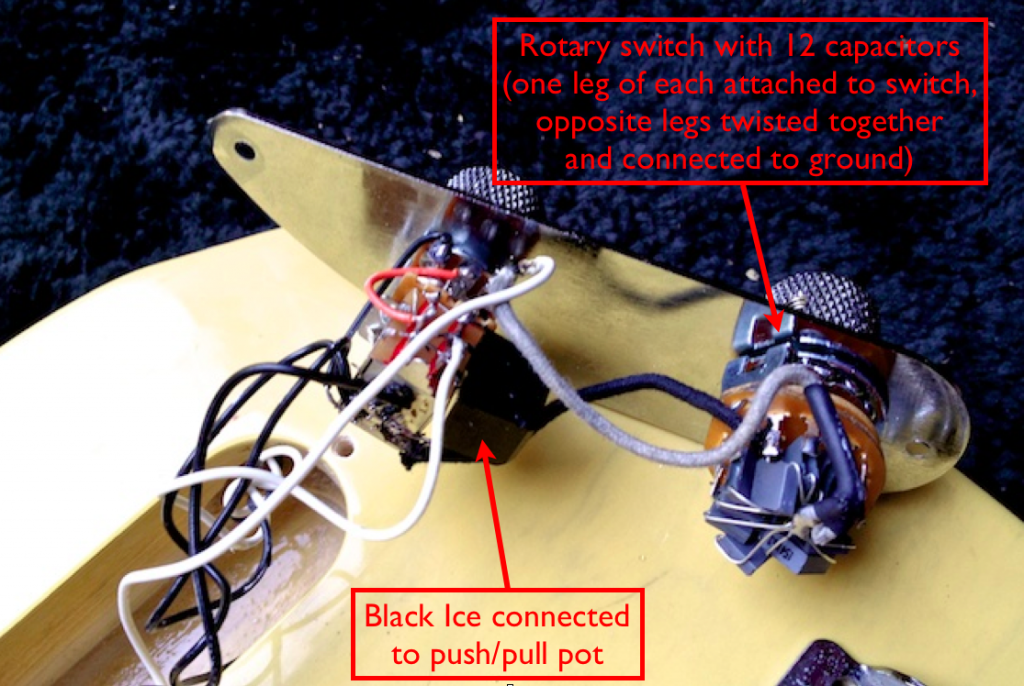
I was eager to audition a multi-capacitor tone control like I wrote about here. (Actually, it’s literally the same tone control — the guitar where it used to reside now houses the Stellartone ToneStyler tone pot covered here.) And while I had the patient on the operating table, I figured I’d also install the Black Ice distortion cube I wrote about here. (My friends in the medical profession assure me that patients always appreciate it when surgeons indulge in improvisational operating-theater mods.)
Demo and details after the break:
(Hover your cursor over the little icons in the lower half of the waveform view for details about what you’re hearing in each portion of the demo.)
(FWIW, the light distortion on the first three phrases comes not from the bass’s electronics or an amp, but from overdriving a tape simulation plug-in I just bought: Universal Audio’s Studer emulation. I’ve been pouring it on everything like a six-year old with a squeeze bottle of ketchup. But the more extreme distortion in the last two phrases is from the Black Ice.)
I’m’a put a cap in your bass. First, let’s talk tone control. The original was your standard Fender-style circuit, with a 250k tone pot siphoning treble as you lower the knob. I replaced the pot with a rotary switch housing 12 different capacitors of ascending values, ranging from a teensy .001uF to a big-ass .15uF (the original cap was a .047, also known as a 473).
One option, of course, would have been to install a modern active tone control — a fine solution, but I wanted to retain the vintage/passive flavor of the instrument. But in the decade or so I’ve owned this bass, I doubt I’ve used the tone control more than once or twice. When I want a darker sound, I tend to EQ the amp or mix, because the simple passive treble bleed just sounds too flat and dull.
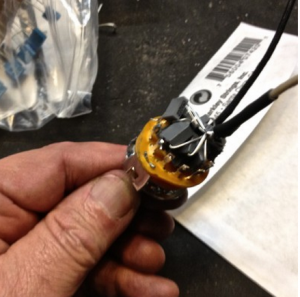
So what, you might ask, is the sonic difference between using multiple caps mounted on a rotary switch, and simply combining a pot and a single cap? After so many months of dicking around with self-indulgent experiments careful study, I believe I can actually answer the question!
Until I started experimenting with Vari-Tones and other multi-captone controls, I never realized how resonant the filter cutoff frequency is on these passive circuits. With a pot and a single cap, you cut highs. But as you switch from smaller to larger caps, you not only cut highs, but color the tone with varying frequencies of resonant “edge.” To my ear, both methods make your tone darker, but the latter is less likely to make it dull.
Twelve caps values is not as excessive it might seem. Once you start focusing on the aforementioned resonant edge, you find yourself thinking not only of filtering off highs, but of “tuning” the control to the key of the track. (BTW, the ToneStyler uses the same concept, but with 16 caps. It’s a superior solution — if you can spare a hundred bucks for a tone control.)
I’m not masochistic enough to record examples of all 12 settings, or sadistic enough to make you listen. So I just recorded the smallest (least treble reduction) cap, the largest (maximum cut), and one midway between.
Anyway, I now feel that a multi-cap switch usually beats a single-cap pot in a passive bass tone circuit. But if I were to do this again, I’d make a couple of changes: I’d add a switch setting with no cap whatsoever, and I’d go all the way up to a .47uF cap (474) for the option of an even darker sound.
Ice is nice. Regarding the Black Ice: As demoed in my previous post, it’s a cool (if limited) onboard distortion that requires no battery. I’d read online comments from other users saying they liked it even better in bass than guitar. I tend to agree. The fuzzy/farty tone just seems to work nicely in a passive bass circuit, and the fact that engaging the distortion makes the volume drop slightly bothers me less on bass than on guitar.
The manufacturer recommends installing the component with a dedicated control pot to regulate the strength of the effect, but I must respectfully disagree with that approach, especially when using lower-output pickups. The lower settings strike me as wimpy, and I prefer to control the drive via playing dynamics. (Also, when paired with a multi-pot tone control, you can reduce the distortion effect by selecting a darker tone. In the demo above, the Black Ice is engaged for the final two phrases. The lighter distortion of phrase 5 relative to phrase 4 is solely the result of changing the tone setting.)
Conclusion. I’m digging this all-passive mod. It expands the instrument’s range without compromising the bass’s retro sound or external appearance. You can buy clean, classy, prefab versions of the components, or make everything yourself for a few bucks if you don’t mind a little mess and duress. Speaking of which, here’s a peek inside the rat’s nest:


Leave a Reply