Sometimes an antiquated idea can acquire new relevance.
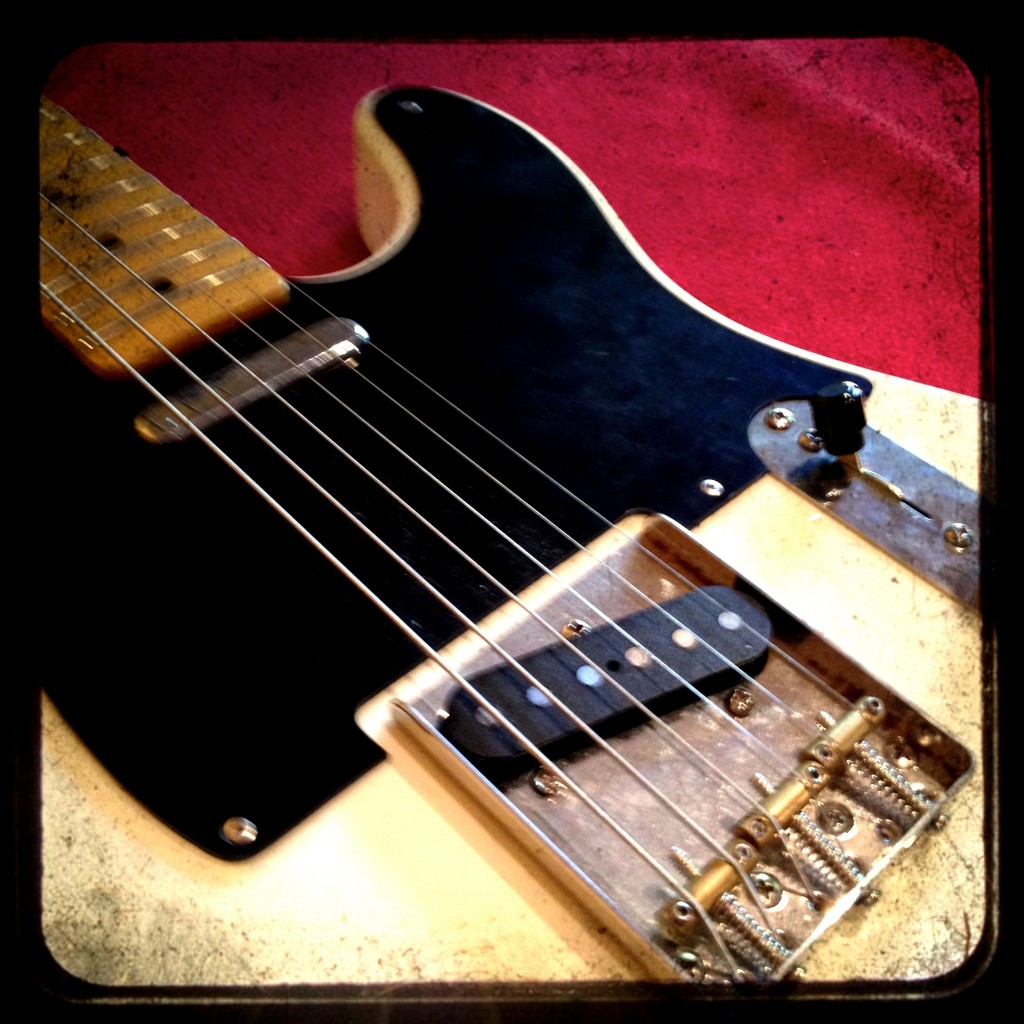
Example: The ancient Fender Broadcaster wiring scheme, in which the guitar has no tone control per se, but the second knob acts as a pickup-blend control. I wired up a guitar this old-fashioned way, with some very surprising results.
My experiment had other motives: I wanted to check out Seymour Duncan’sVintage Broadcaster Set, which replicates those earliest Telecaster-family pickups. And once again, I wanted to see just how much of a sonic upgrade a simple pickup replacement could bestow on a humble guitar: in this case, a cheap, Chinese-made Squier Telecaster.
Check out the results in the demo video.
With the Broadcaster blend wiring, the middle pickup-selector position gives you pure neck pickup. Switching to position 3 (regular neck position on standard Teles) engages a tone-filtering capacitor for a much darker neck-pickup sound. The second knob does nothing in positions 3 and 2, but when you move to position 1, it fades in the neck pickup along with the bridge pickup. Fully clockwise, you get the usual position 1 sound. Fully counter-clockwise, you get the usual position 2 sound. And anywhere in between (this is the cool part) you get tones you simply can’t get from regular Tele wiring.
This wasn’t my first encounter with this wiring. But like many players who’ve tried it over the last 60 or so years, my first reaction was that position 3 was simply too dark to be of much use, and I was reluctant to sacrifice a proper tone control. (BTW, this wiring predates the Fender Precision Bass. Back in the day, this may have been as close as you could get to a good, amplified solidbody bass sound.)
But in the years since I’ve last tried the blend setup, I’ve spent a lot more time with Tele-family guitars, and I’ve realized that, while I use the tone knob often, I tend to use it in two specific ways:
- • to roll of a smidgen of highs on the bridge pickup
• to roll all the highs off the neck pickup for EBow playing, or for creating bass parts in bands without a bassist (like my current group, Mental 99).
Meanwhile, I rarely find myself hanging out for long in the middle position, with both pickups engaged. It’s not a bad sound, but it never seems to thrill me like the brilliant bridge and fat neck sounds do.
The blend arrangement (or at least the modded version I detail below) affords all the tone control I need. Switching to position 3 gives me an instant bass and EBow setting. I don’t miss not having a dedicated tone control for the bridge, because mixing in a bit of neck tames the nastiest highs. And oh my, there are some terrific sounds available along the range of the blend knob in position 1!
Here’s the wiring diagram from the Seymour Duncan site, with my notes added in red:
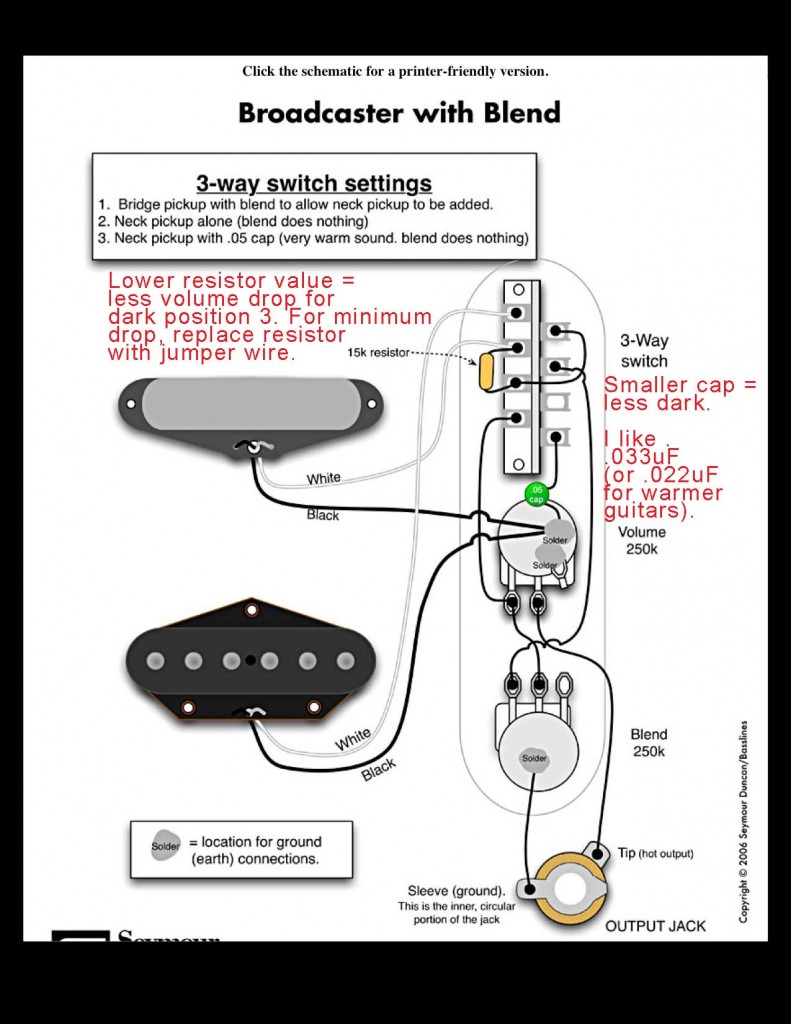
The value of the capacitor linking the selector switch and volume pot determines the darkness of the position 3 sound. (There’s a deeper discussion of tone control caps in this post.) I tried several other values, and prefer a slightly less dark .033uF cap, and that’s what you hear in the demo for both guitars. However, after playing a gig with the Trussart (which is substantially warmer in tone than a classic Tele), I’m going to replace its .033 with an even less dark .022uF.
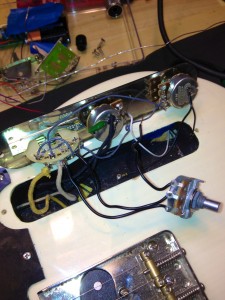
Meanwhile, the resistor on the selector switch determines how much of a volume drop you get when switching to dark position 3. I temporarily replaced the resistor with a B50K pot so I could audition different values. My favorite setting: no resistance at all. I simply replaced the resistor with a jumper wire, and balance feels about right. (Again, that’s what you hear in the demos.)
I performed these mods switches less than 24 hours ago, but I’m sold! I have all the control I need. I spend much less time adjusting pots. And I love the blend pot’s in-between shadings. It’s an easy project, too.
Has anyone else tried this? More important, has anyone tried it and not hated it?


Leave a Reply