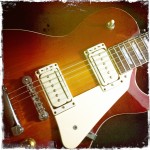
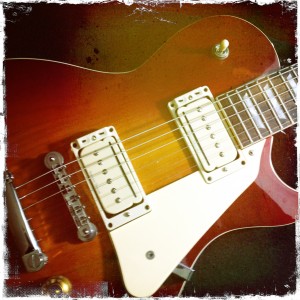
 A while back a couple of readers brought up Jimmy Page’s Les Paul wiring scheme, which made me want to set up a dual-humbucker guitar with lots of those tricky series, parallel, and split-coil tricks. Meanwhile, I wanted to do a sequel to my last cheap guitar makeover, but this time with a solidbody instead of a semi-acoustic. Also, I’d been meaning to try a pickup combo recommended by the mavens at Seymour Duncan: a pair of P-Rails combined with Triple Shot Mounting Rings.
So I slaughtered all three birds with a single stone: I picked up a late-’80s Aria Pro II for $200 and retrofitted it with that absurdly versatile pickup scheme. Have a listen!
This was a fascinating experiment. I’m usually not much of a pickup blender — I’m likelier to flick between pure bridge and neck tones. (Also, a nasty little guitar I had when I was young soured me on parallel/series wiring tricks. You could choose between nasty, brittle tones and dull, farty ones.)
The P-Rail is a clever design consisting of an alnico blade pickup and a P-90 mounted side-by-side. When combined with a Triple Shot mounting ring, each pickup yields four distinct colors: each coil solo, or the pair combined as a humbucker in either series and parallel configuration.
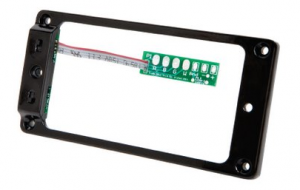
Installation was shockingly simple. P-Rails are four-connector pickups. When used with Triple Shots, the color-coded wires are soldered onto the mounting rings’ pads. The output from the mounting rings is single-connector, so linking the Triple Shots to your tone and volume pots is a breeze. It’s way easier than making all the four-connector connections inside the control cavity, at least if you’re a klutz like me.
Once everything’s installed, you select coil combinations via a pair of mini-toggles on each Triple Shot. It feels a bit odd at first switching sounds this way, but within minutes, I had the four settings under my fingers and could select tones by feel alone. It’s a fun rig to play, one that yields a ridiculous number of sounds, especially when you blend the pickups and start fiddling with their relative volume and tone settings.
A word about the guitar: It’s a perfectly decent instrument, but definitely nothing special. I just wanted a stout block of wood with acceptable hardware and electronics, routed for two humbuckers. It looks vaguely Paul-oid, but its bolt-on neck rules out the sort of ringing sustain you’d expect from a fine Les Paul. You can probably achieve similar results at a similar price with any number of non-trendy used axes.
Now please be so kind as to share your mongrel makeover adventures!


Leave a Reply