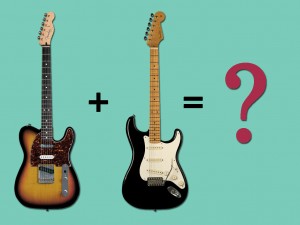
I’ve been coveting one of those “Nashville-Style” Telecasters — you know, the hot-rodded, three-pickup versions popularized by Nashville session superhero Brent Mason, and now a regular Fender production model.
Then it dawned on me: Since some of Mongrel Strats I’ve been playing with have strong Tele tendencies, why not flip the equation? Instead of a Tele that acts like a Strat, why not a Strat that thinks it’s a Tele?
The Fender version replaces the usual Tele 3-way switch with a 5-way, as shown in this wiring diagram, though many players prefer to keep the 3-way switch and add the middle pickup via a blend knob, as in this other wiring diagram.
I took the latter approach, and I am flipping out over all the new tones it unlocks. Check out this little video demo:
The disadvantage of the blend-knob version is, you no longer have access to the sound of the middle pickup alone. (As if I care — it’s the most boring sound on a Strat!) One the other hand, you get the splendid sound of the outer pickups together — something you can’t obtain on a standard Strat. Better still, you can adjust the amount of middle pickup added to the combined settings, unlocking many cool shadings unavailable on a conventional Strat. You can also dial in the sound of all three pickups together, another combo unattainable on regular Strat. (Generally, this setting doesn’t do much for me, though I love it when using a Tele-caster style bridge pickup, like the Seymour Duncan Twang Banger I have in this guitar. (The neck pickup is a Duncan SSL-1. The middle pickup is also an SSL-1, but reverse-wound, reverse-polarity version.) All that in exchange for sacrificing middle pickup alone? Such a deal!
Aside from the sounds, I dig the concept of this wiring scheme. Now I think of the “out of phase” sounds not as pickup-selector positions, but as a character accessible at all times. With the middle knob turned left, you get sharp, crisp Tele/Strat tones. As you rotate it to the right, the colors get softer, prettier, and more diffuse. As I mention in the video, it reminds me of the focus and aperture controls on a high-end camera. It makes me think differently and play differently — and those are almost always good things. 🙂


Leave a Reply