This post is about a guitar wiring scheme that only geeks and tweakers could love.
I think you’ll dig it. 
In Phase 1 of this project, I recreated the original Page wiring scheme using an ’82 Paul, a pair of Duncan ’59 model pickups, and four push-pull pots. The result was a great-sounding, almost absurdly versatile guitar, though the sheer number of options was downright bewildering.
So naturally, the only way forward was to make the instrument even more bewildering by adding additional sonic options. This version offers all the sound of the Phase 1 model, and a buttload more. Several buttloads, actually — and I’m not talking about those skimpy metric buttloads!
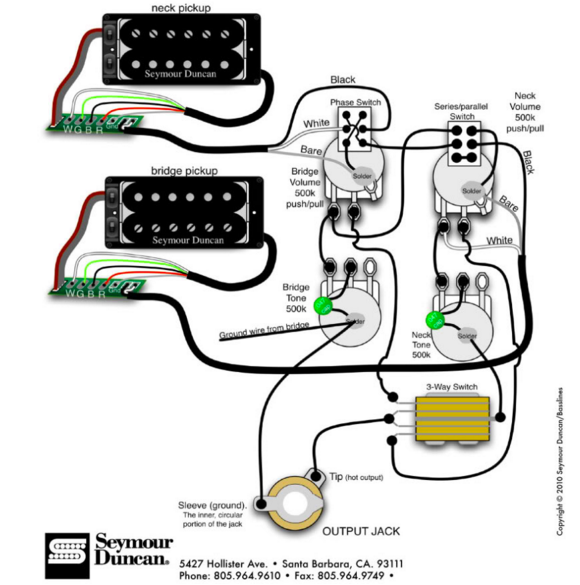
I gutted all the Phase 1 electronics. (Man, that hurt!) Next, using the same pickups, I added a pair of Duncan Triple Shot Mounting Rings. These provide four settings per pickup: humbucker, inner coil split, outer coil split, and both coils in parallel. (The Phase 1 plan offers only one split-coil setting per pickups. While you can configure the two pickups in parallel, you can’t do so with the individual coils in each pickup like you can here in Phase 2.) Here’s the wiring diagram I worked from, which for some reason is no longer posted on the Duncan site.
Since the Triple Shots add four new switches, the Phase 2 wiring requires only two push/pull pots. I wan’t about to let that real estate go unused! I installed a homemade germanium overdrive circuit (similar to the one we made in DIY Club) inside the guitar. My third push/pull pot activates it, and the fourth selects between two input caps, so I get a choice between a fat, Sabbath-style drive and a brighter, thinner Bluesbreakers-type tone.
Check out the demo video:
At some point I said I’d perform the Phase 2 surgery with a pair of Duncan P-Rails, which, unlike the ’59s, were specifically engineered for coil-splitting. with one coil yielding a Fender-type single-coil sound, and the other mimicking a P-90. And I did try that — and simply didn’t like it as much as the results I got with the ’59s.
Don’t get me wrong — the P-Rails are cool pickups, and I love how they worked for me in this post. But on this particular guitar, the retro flavor of the ’59s just moved me more. (And as I mentioned out in Part 1, I’m blown away by how great the ’59s sound in split-coil mode.) The only disadvantage of the ’59s is that there’s less contrast between the split-coil sounds within each pickup. Still, I hear plenty of difference between the two bridge-pickup coils. And while the two neck-pickup coils sound similar when heard solo, switching between them brings out cool shadings in blended settings, especially the out-of-phase ones. So I’m cool with the compromise. 🙂
A few words about the onboard booster: If you’ve built the Fiendmaster project from DIY Club, you’ve probably noticed that it fits on a tiny piece of perfboard. It was easy to fit the circuit and a 9-volt battery inside the Paul’s control cavity — a lot easier than cramming it into a standard Strat-type guitar!
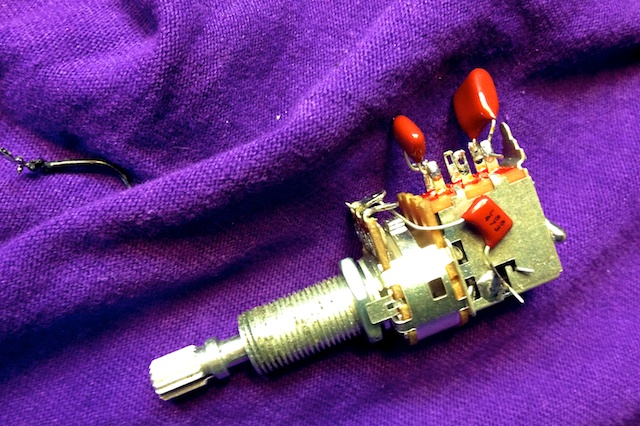
I replaced the guitar’s mono input jack with a stereo jack, and connected the battery’s negative terminal to the jack’s middle lug so there’s no current draw when the guitar is unplugged. (And FWIW, a simple boost circuit like that, with no power-indicator LED, runs for months and months on a single battery.) I omitted the input capacitor from the perfboard, but wired two different input caps to one of the vacant push/pull switches, as shown in the photo. Works great! (You could use the same technique to switch between two different tone-pot cap values — a sort of minimalist Vari-Tone.)
Man, I learned so much from this process! I’m now a total convert to split-coil humbuckers, and I’m becoming addicted to the out-of-phase sounds as well. The in-series sounds, both per pickup and between the two pickups, thrill me less, though I hear a few cool tones, and perhaps they’ll be perfect in some musical contexts.
But that’s the coolest thing about this exercise: You can pick and choose whichever aspects you dig the most. For example, I’d be totally stoked to play a dual-humbucker guitar with, say, two volume controls and one tone control, with coil splits and a phase switch accessible via three push/pull pots.
So: Can anyone who’s not a math dope like me calculate the number of available settings for the Phase 1 and Phase 2 projects? (Not counting the variations you get by adjusting relative pick balances, tone controls, or overdrive circuit — just the basic pickup combinations.)


Leave a Reply